Recording Profiles
Recording Profiles are used for recording Teams calls; the Recording Profiles page does not exist for SIPREC only systems. For SIPREC, see Device Recording Profiles.
Recording profiles configure the recording capabilities of AAD groups of targeted users. A profile may be assigned to one or more groups. In the Quick Start wizard, you created an initial Recording profile. You can modify this profile and create additional profiles. The Recording profile includes the following capabilities:
| ■ | Determines which call types may be recorded. |
| ■ | Sets Data Retention policies. |
| ■ | Configures Azure Blob Storage region location to store calls. |
| ■ | Attaches AAD groups including Targeted users to recording profiles. |
| ■ | Blocks recording of calls according to specific numbers. |
| ■ | Determines the time of day you wish to record or to prevent recording of targeted users. |
| ■ | Configures Microsoft Teams Calling Policies. |
| ■ | If assigned an Analytics profile, enables transcription of recordings, and optionally generating of AI-powered summaries from these transcriptions. |
To comply with Microsoft Bot Grouping API for meeting recording, storage optimization and avoiding redundancy, Live Platform implements the following policy for recording large meetings:
| ■ | Recording: Live Platform stores only one copy of a meeting recording for the organizer, regardless of the number of targeted participants. For example, in a 300-person call with 300 targeted users for recording, Live Platform stores one copy of the call for the organizer and another recording for the rest of the 299 users. This ensures efficient use of storage space. |
When users belong to different recording policies, the result is one recording for all users of the same recording policy.
| ■ | Playback: Playback of a user recording of a meeting starts from the point the user joins the meeting and ends when user leaves the meeting. |
| ■ | Retention Period: The retention period for recordings is based on the recording profile retention period of the targeted users. The longest retention period among the recording user groups (organizer vs. the rest of the targeted users) will apply. |
Download of meeting is not supported.
See also:
| ■ | Add a Recording Profile |
| ■ | Modify a Recording Profile |
| ■ | Synchronize a Recording Profile |
| ■ | Recording Profile-Call Type Configuration Examples |
| ■ | Disable a Recording Profile |
| ■ | Delete a Recording Profile |
| ➢ | Do the following: |
| 1. | In the Icon pane, click  , and then in the Navigation pane, select Recording Settings > Recording Profiles. , and then in the Navigation pane, select Recording Settings > Recording Profiles. |
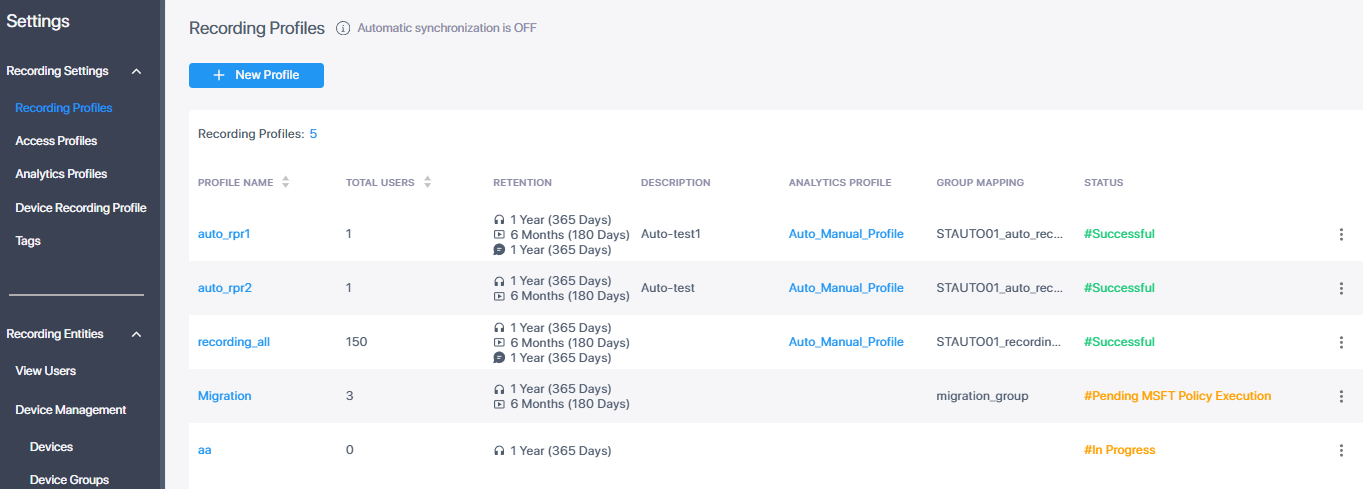
The table below describes the parameters in this table.
|
Field |
Description |
|---|---|
|
Profile Name |
Enter a name for the new recording profile. |
|
Total Users |
The total number of users with Targeted user recording licenses. |
|
Retention |
Retention time period for calls associated with the profile. Default: One year. |
|
Description |
Description of the recording profile. |
|
Analytics Profile |
The analytics profile attached to the recording profile (if existing). Click the analytics profile to view its details. |
|
Group Mapping |
Azure tenant Security group that is mapped to this profile. |
|
Status |
Indicates the status of the synchronization with Azure tenant (see below). |
|
Statuses |
|||||||
|
|
AAD Groups are not synchronized with your M365 platform due to one of the following:
See Synchronizing AAD Groups with M365 Tenant Platform |
||||||
|
|
Indicates that changes have been made to a Recording profile and as a result, the Microsoft script must be downloaded and run into to apply the changes to synchronize with your M365 platform. |
||||||
|
|
Indicates that the profile has been disabled. See |
||||||
|
|
Indicates that the Recording Profile has been successfully synchronized with your M365 platform. |
||||||
|
Error |
Indicates that the Recording Profile has an error. |
||||||



